
Analytics
The Market That Breathes by the Calendar
Seven years of data show that Kazakhstan's real estate market moves in cycles and that every departure from the pattern bears the mark of a regulatory decision. Why the market is quiet now—and why the pause will not last forever.

The real estate market is often treated like a force of nature: it rises and falls, and its direction is supposedly impossible to predict. The data say otherwise. Analysis by Ruslan Zhusupov, founder of the Prime Estate commercial real estate agency, shows that the market moves by the calendar, repeats the same shape year after year, and breaks its rhythm only when the rules of the game change.
This article draws on seven years of nationwide residential sale statistics, from 2019 through the middle of 2026. The picture is rhythmic rather than chaotic. January is the low. December is the peak. Summer is quiet, while autumn brings a business upswing. This shape repeats with very little change. Wherever it breaks, there is always an event behind it: a pandemic, war, pension reform, or a new tax.
The market is now in a cooling phase. Transaction volumes are lower, demand has softened, and the word “stagnation” is being heard more often. Yet the mechanics of this pause reveal not a verdict, but a normal part of the cycle—one that is already beginning to turn.
Rules, not sentiment, move the market. Those who can read the rules gain a six-month head start.
01 · Rhythm. The market breathes by the calendar
Start with the most stable pattern. Average the monthly activity from 2019–2025 and set the year's average level at 100, and a clear curve of the market's “breathing” emerges.
January sits at 78, almost a quarter below average: the market sleeps after the holidays. By March it returns to normal and mortgage activity resumes. Summer traditionally dips as holidays create a pause. Autumn becomes the business peak: September through November remains consistently above average. December rises to 128 as year-end closing combines with a rush to act before new rules, which almost always take effect on January 1.
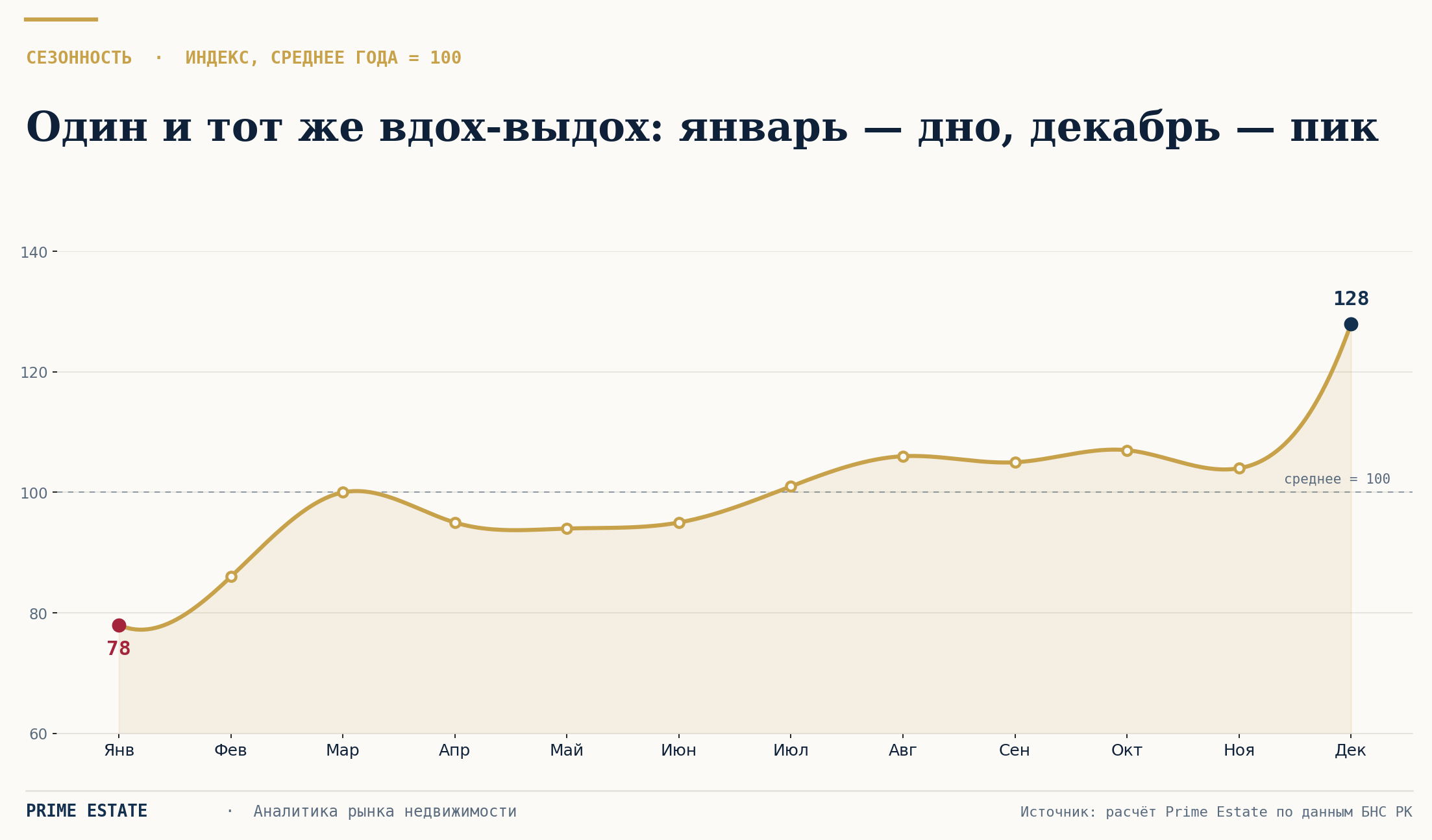
This is the basis of timing. A disciplined investor buys in the quiet months— January or July—when competition is lower and sellers are more flexible. The investor sells into the peak, in autumn or December. The market itself indicates when to enter and when to exit; the task is simply to hear it breathe.
02 · Amplitude. One rhythm, different years
The shape repeats; only its amplitude changes. Annual transaction volumes show that the country's normal range is roughly 300,000–450,000 sales a year. Every departure from that corridor has a name and a cause.
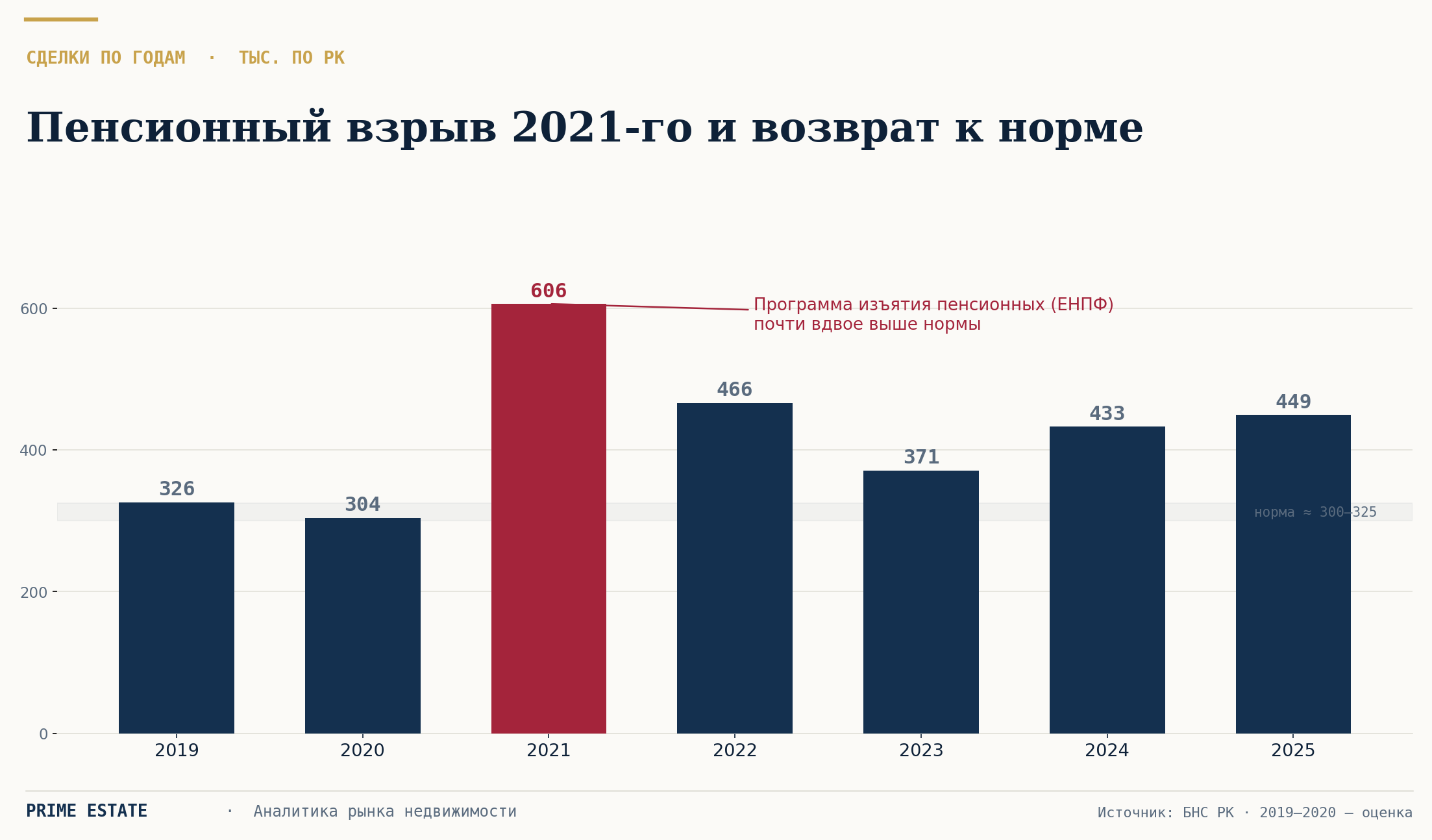
The record came in 2021, with 606,000 transactions. December of that year stands apart: 94,988 transactions in a single month, the highest figure in the entire record. This was not driven by “faith in property,” but by a specific decision: citizens were allowed to use pension savings for housing. Open the tap and the market boils; close it and the water recedes.
The central principle is visible here: the norm is the shape, while the anomaly is the result of a decision.
03 · Broken rhythm. Events—not emotions—break seasonality
Every surge and every decline in recent years has coincided with a change in the rules or an external shock. This is a pattern, not a coincidence.
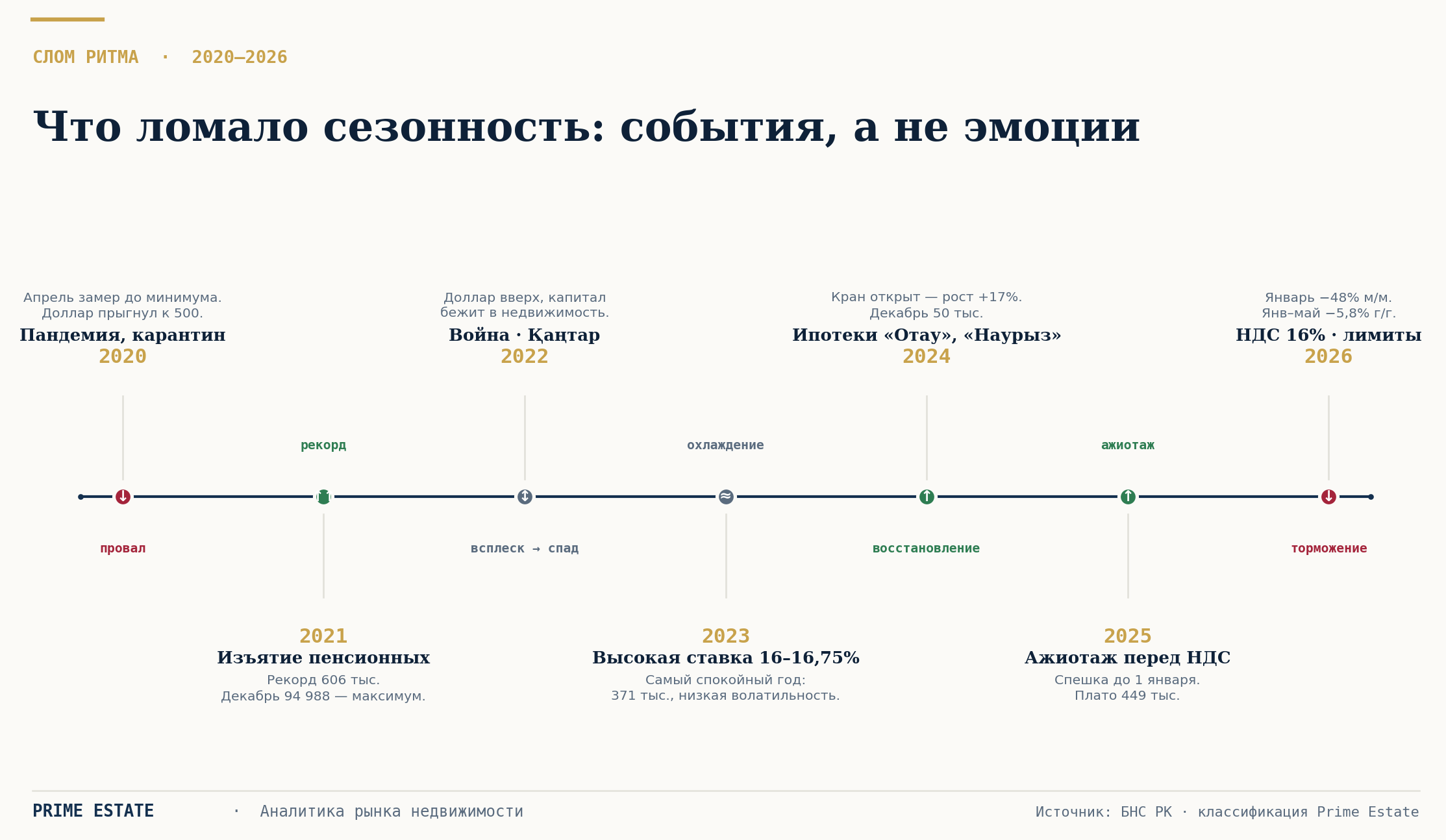
2020 — the pandemic. April froze at the period's low. The dollar jumped from its previous 370–380 range to 500 at exchange offices. Deferred demand then arrived in the second half of the year.
2021 — pension withdrawals (UAPF). Demand exploded: 606,000 transactions for the year and 94,988 in December, an all-time monthly high. This was the pure effect of one regulatory decision.
2022 — war, Qantar, and relocation. The start of the war in Ukraine pushed the dollar upward again, while the January events at home added anxiety. Capital sought a safe haven in property. The final surge came in the first quarter, followed by a decline through the rest of the year.
2023 — a high base rate (16–16.75%). The quietest year in the period brought 371,000 transactions and low volatility. Expensive money cooled the market without any shock, through the mathematics of interest rates alone.
2024 — the new Otau and Nauryz mortgages. The state reopened the tap, and the market responded with growth of almost 17%. December recorded 50,000 transactions. The programme created demand where the market would not have found it on its own.
2025 — the rush before VAT. Buyers hurried to close before January 1, 2026, while developers were still exempt from the tax. The market held a high plateau of 449,000 transactions. December reached 53,128, a three-year record. This was a classic rush to act before future tightening.
2026 — 16% VAT and credit limits. The rules changed, and the market exhaled. January fell 48% from December. January through May was down 5.8% year over year. This is the cooling phase the market is in today.
An anomaly is not an accident. It is the imprint of a decision. A sharp rise before tighter rules is a reason to take profit, not chase the market.
04 · Today. Why the market became quiet now
No guesswork is needed to explain the current pause. Several regulatory burdens landed on the market at once, and each pulls demand lower.
First, VAT. From January 1, 2026, developers pay value-added tax of 16%, instead of the previous zero rate; the exemption is gone. The tax enters both the price of an apartment and the cost of construction materials. An important detail is often missed: the full effect is delayed. VAT applies to projects started after January 1, and those buildings still need to be constructed. The actual increase in new-build prices will therefore unfold in 2027–2028. Psychologically, however, the market has already reacted.
Second, expensive money. The base rate remained at an unprecedented 18% for eight months. Market-rate mortgages became almost inaccessible, demand relied on state programmes with their limits, and the market-rate buyer simply stepped away.
Third, new barriers. The tax-free holding period for housing increased from one year to two. Purchases in buildings under construction must now be cashless and processed through a bank. A new Construction Code takes effect in July, with structural warranties of five and even ten years. These measures improve market quality, but in the short term they raise costs and remove weaker players.
The key feature that distinguishes the present cooling from earlier phases is the absence of a currency shock. In 2020 and 2022, the dollar surged and households rushed into property to protect their savings, inflating the market through fear. Today the tenge is holding around 486 and the exchange rate is stable. The fuel that once turned every pause into another round of growth is therefore absent.
This makes the cooling cold rather than panicked: rates and taxes suppress demand, while the currency remains quiet. Prices in tenge are nevertheless holding and even rising. New-build prices gained about 14% in 2025, led by Astana and Almaty. There are fewer sales and higher price tags. That is a warning sign: price has detached from the number of genuine buyers. These are the moments when the word “bubble” begins to surface.
The practical conclusion is straightforward. When transactions fall while prices rise, the market is not “appreciating”; it is narrowing. There are fewer buyers, and those who remain are overpaying. This is not the time to chase price, but to calculate. A scarce, liquid property will pass through any phase. An overpriced one will stall.
05 · The turn. The cycle is already changing direction
A cooling phase does not hang in the air forever. Signs of the exit are already visible in the data, not merely in expectations.
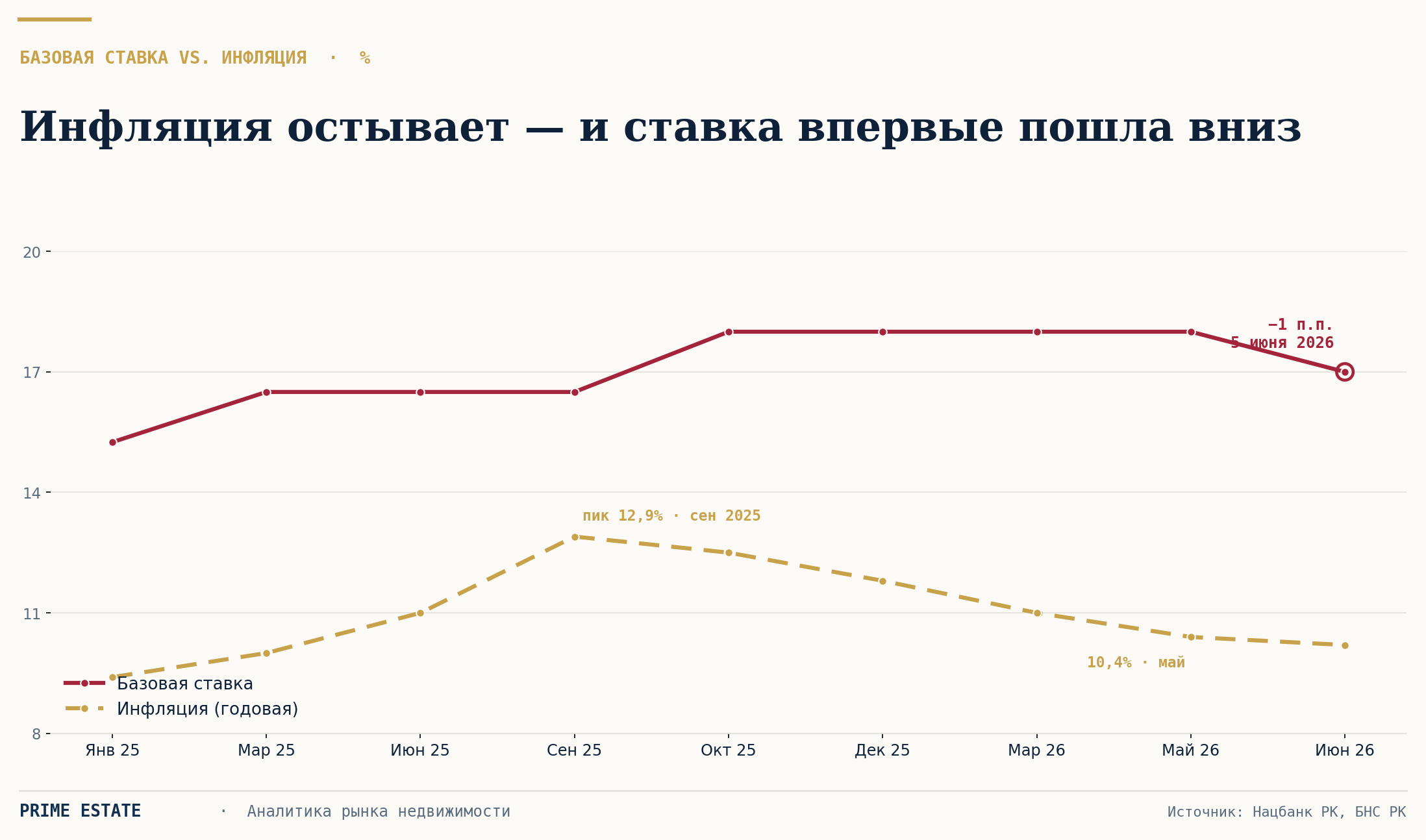
The rate has started to fall. On June 5, 2026, the National Bank reduced the base rate from 18% to 17%, the first decline in the cost of money since mid-2024. The move was bolder than forecast: the market and major research houses expected 17.5% at best. The regulator deliberately provided a stronger impulse to business activity. This is not cosmetic; it signals a change of direction.
Inflation is slowing. From a peak of 12.9% in September 2025, annual inflation fell to 10.4% by May. The tenge is strong and price pressure has eased, giving the National Bank room to act. The more durable the decline, the further the rate can fall—and mortgages can become cheaper behind it.
The state is reaching for the tap again. A renewed Nauryz programme at 7–9% launched in spring 2026, the return of the Umai women's mortgage was announced, and Otau and 7-20-25 continue to operate. The logic is familiar: when demand weakens, subsidised lending is activated. The market saw this lever in 2024 and responded with growth.
06 · Conclusion. Why the cooling cannot last long
The picture is consistent. The market is cyclical. It cooled not by itself, but under the weight of tax, expensive money, and new barriers. Yet the rate has begun to turn, inflation is retreating, and the state is bringing proven incentives back into use.
There is also a fundamental reason why no one will allow the cooling to persist. Construction is not just developers; it is jobs, contractors, banks, suppliers, homebuyers' funds, and dozens of adjacent industries. Freezing construction for a long time would damage employment, ordinary families' money, and the wider economy. In every cooling phase, the state is therefore eventually forced to put a safety net in place—through a new credit programme, a softer rate, or targeted support for demand.
Kazakhstan's property market is too important to be allowed to stand still for long. Cooling is a reset pause, not the beginning of a collapse. It ends when the cycle refreshes and enters another turn.
Construction cannot remain frozen for long. This is no longer only about real estate; it is about economic resilience. Support is therefore inevitable.
Seven years of data produce three rules for people with capital.
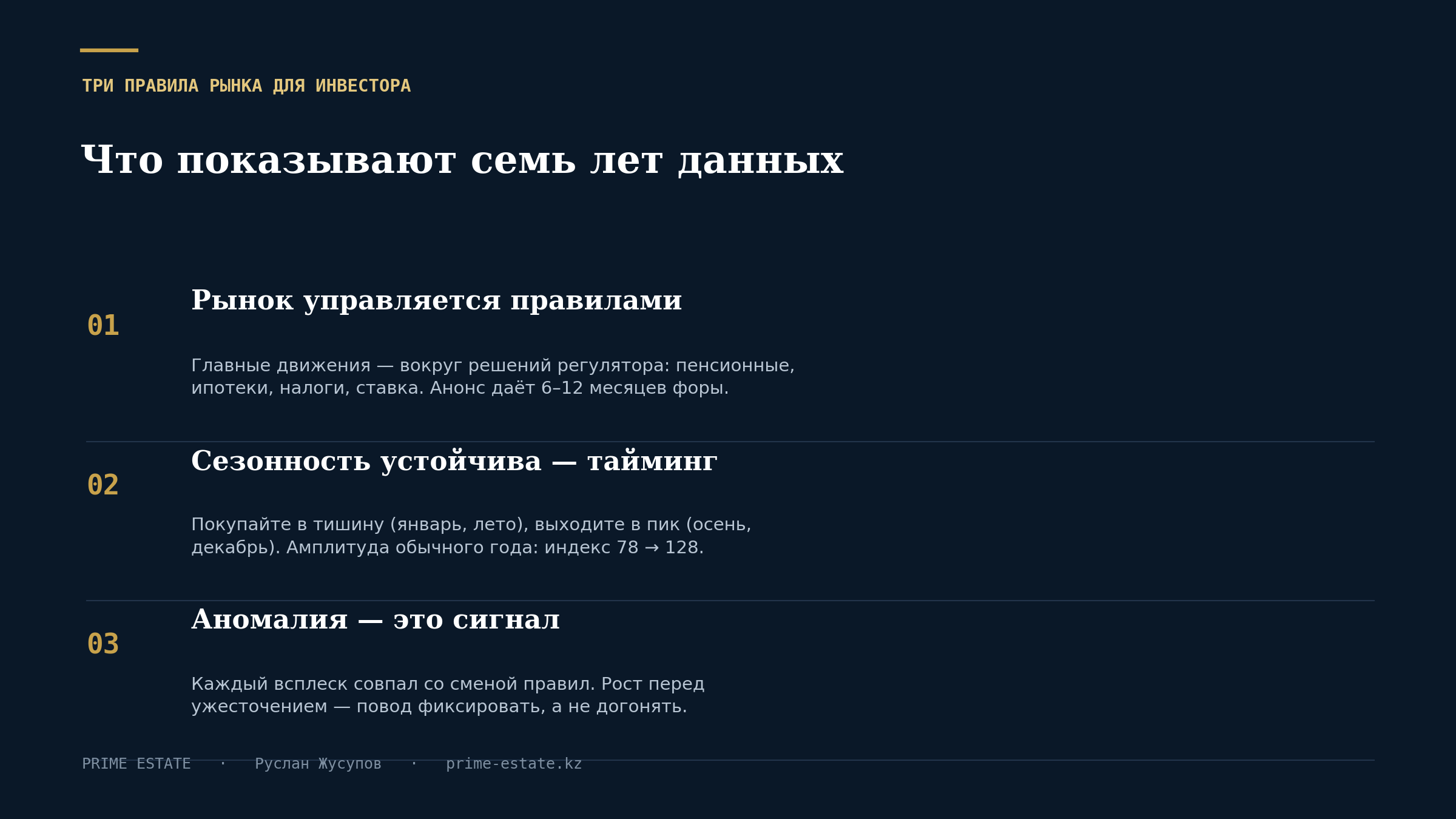
First, rules move the market. The main shifts form around decisions from above: pensions, mortgage programmes, taxes, and the base rate. A regulator's announcement provides a six- to twelve-month lead—an opportunity to act before the crowd.
Second, seasonality is stable, and timing works. Entering in the quiet months (January–February and summer) and exiting at the peak (autumn and December) captures a range from an index of 78 to 128. It is effectively free margin for those who know how to wait.
Third, an anomaly is a signal, not an accident. Every surge and decline has coincided with a rule change. A sharp rise before tightening is a reason to take profit, not chase the price. A deep cooling phase like today's is a time to prepare for the turn while others are still afraid.
The market is now at the lower point of its breathing cycle. Many see only risk. But seven years of figures say one thing: the market always breathes in again. The question is who will already have selected the right property when it does—and who will be chasing a more expensive square metre.
Data sources
Public data. Bureau of National Statistics of Kazakhstan (stat.gov.kz): the number of registered residential sale transactions by month and year, and annual inflation. National Bank of Kazakhstan (nationalbank.kz): the base rate, the June 5, 2026 decision, and the official tenge exchange rate. Kazakhstan's Tax and Construction Codes: 16% VAT, holding periods, and developer warranties. Otbasy Bank programmes: Nauryz, Otau, Umai, and 7-20-25. Business publications: Kursiv.media, Krisha.kz, Inbusiness.kz, and Tengrinews.
Prime Estate proprietary analysis. The combined monthly and annual series for 2019–2026, the seasonal index calculation, the classification of anomalies and their connection to regulatory events, and the conclusions about cycle phases and timing are Ruslan Zhusupov's proprietary methodology. Some monthly observations for 2019–2024 were reconstructed from the seasonal profile and anchored to actual Bureau of National Statistics reference points.